After the demo works: five checks for an AI‑built app
Five checks to run before trusting an AI-built app with payments and customer data, illustrated with fixes from public Ruby and Rails projects.
A checkout demo ends when the order confirmation appears. The payment provider still has a webhook to deliver, the app has access to provision, and a worker can stop between those two steps. I start a production review by following that order one step further.
I chose five checks from bugs I fixed in public Ruby and Rails projects. They apply to apps built with AI coding tools as well. The pull requests document specific failures and fixes. They do not tell us how the original code was written or how often these failures occur.
Try a duplicate delivery, a second account, a cancelled request, an unexpected input, and a tool that reports failure. Start with the flow whose failure would cost a user money or access.
If you only have a minute, this image is the whole post:
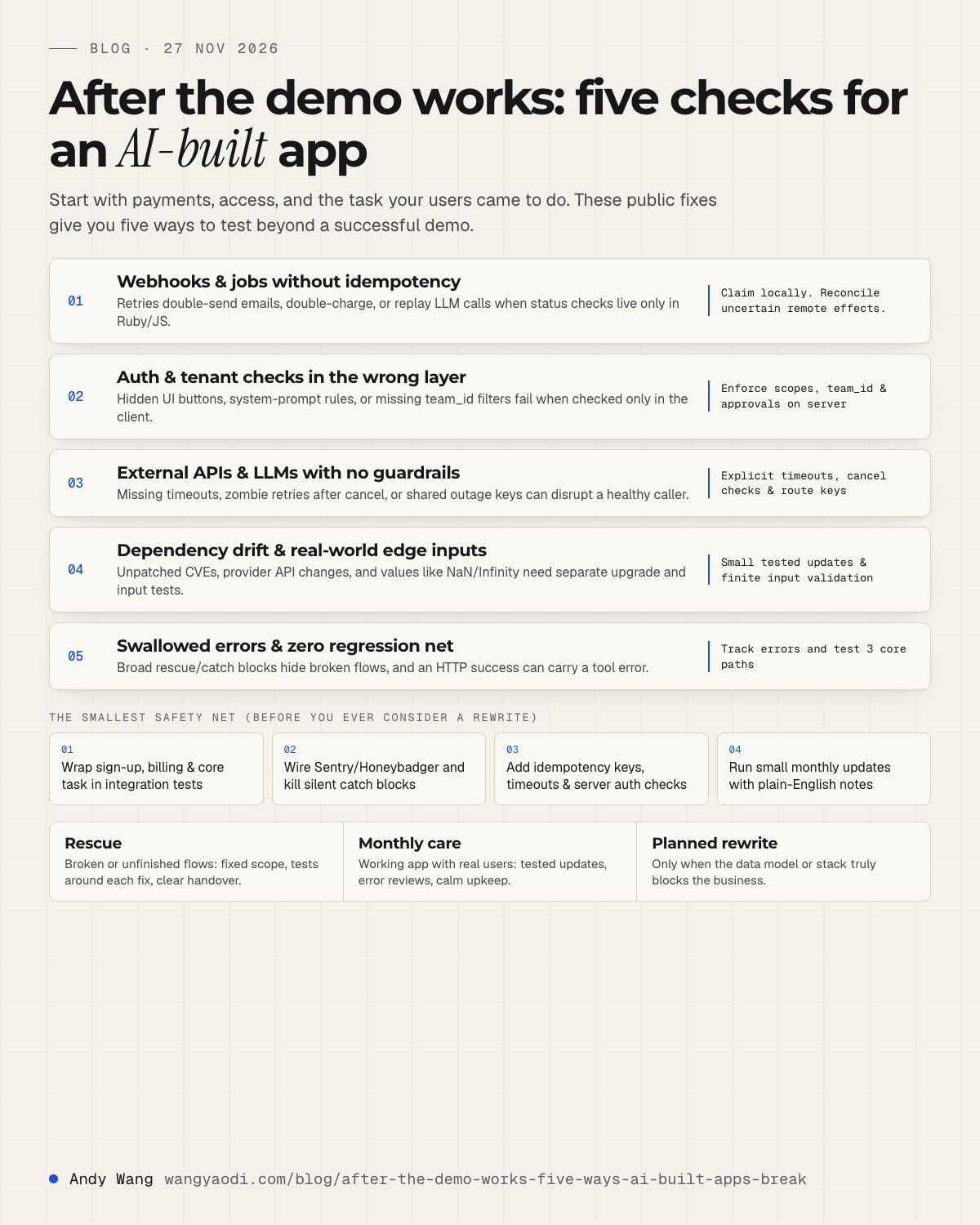
Why a passing demo hides five specific faults
Take an order that should grant one month of access. A passing demo shows that one payment can create an entitlement. Deliver the same event twice to a test handler, then count entitlements and queued notifications. Checking only for a successful HTTP response misses both duplicates.
Demos test one user, one click, and one clean network response. All five production faults sit right outside that happy path.
1. Webhooks, payments, and background jobs have no idempotency
Stripe documents duplicate webhook deliveries. Queue redelivery depends on the adapter and its retry policy. If your handler checks if order.pending? in memory and then charges, mails, or provisions access, two overlapping deliveries both pass the check. Even OAuth callbacks suffer from this: in Chatwoot #16699, consuming an OAuth callback state had to be made atomic so a replayed callback couldn't reuse it.
Payment webhooks, OAuth callbacks, and queued jobs arrive more than once. Without a duplicate guard, repeated deliveries can send emails twice, bill LLM calls twice, or corrupt state.
Lewsnetter #61 moved a campaign’s eligibility check and transition to sending under one row lock. ActiveAgent #664 claims a pending run with one conditional update. In each case, overlapping deliveries get one winner. If the winner dies after an external service acts, its local claim cannot tell a successor what happened. Persist an operation ID, reuse it where the provider supports idempotency, and reconcile an unknown outcome before retrying.
2. Auth, tenant isolation, and tool permissions live in the wrong layer
In a demo built for one founder account, hiding a Delete button in React or writing "always ask the user before deleting" in a system prompt looks like it works. With real customers, every security check has to live on the server, scoped to the authenticated account or team.
Never trust hidden buttons or system prompts for security. Enforce tenant scoping, OAuth scopes, file path boundaries, and destructive-action approvals on the server.
Even well-maintained open-source apps miss these boundaries until someone probes them:
- Unchecked token scopes: In Lewsnetter #35, OAuth consent advertised
mcp:readas read-only, while the middleware let read-only tokens call destructive tools until explicitread_onlyopt-ins were enforced before execution. - Prompt-only guardrails: In Lewsnetter #53, destructive agent tools needed server-side
requires_approvalpauses because untrusted text inside tool results can steer a model past a system prompt. - Missing tenant scoping on child records: In Lewsnetter #97, events created under a subscriber were missing the subscriber's
teamassociation. Authorization denied a legitimate creation: the API returned 404 and the account form redirected. The fix assigns the subscriber’s team before authorization. - File-store boundary: In RubyLLM #1677, chat-store paths needed to refuse symlinks pointing to folders inside the store boundary.
3. External calls can keep retrying after cancellation
For each external call, find the timeout, the retry policy, and the point at which cancellation takes effect. If callers share a failure cache, find which connection settings identify a route.
Every outside HTTP or LLM call needs an explicit timeout, a cancellation check before retrying, clean error handling when credentials disappear, and tenant-isolated outage keys.
Four public fixes show why those details matter.
- A shared outage key: In RubyLLM #1577, outage backoff was keyed only on the server URL, so a failed proxy route could hide tools from a healthy direct connection to the same URL in the same process.
- Cancelled work keeps retrying: In RubyLLM #1729, GET and DELETE requests kept retrying after the user had already cancelled the chat; in MCP Ruby SDK #709, a terminated session had to cancel in-flight requests before closing streams.
- Missing credentials crash instead of returning 401: In RubyLLM #1578, a job whose user disconnected threw an uncaught
NoMethodErrorinstead of a typedUnauthorizedErrorthe app knew how to handle. - Operational check: Count provider attempts per logical user request so retries appear in usage reports.
4. Dependencies drift, edge inputs slip through, and deploys turn stressful
An upgrade and an input check solve different problems. Lewsnetter #55 updated Puma for seven advisories. In Rails #59853, an odd/even validation raised an exception on a non-finite value. Chatwoot #16718 and RubyLLM #1697 rejected non-finite numbers before they reached JSON serialization.
Apps rot even when you stop editing them. Packages accrue CVEs, providers change APIs, and weird real-world inputs break unvalidated assumptions—so updates feel scary whenever there are no automated checks.
For an import, check the meaning of the accepted value. In Sure #5690, the sample Mint CSV’s debit of -8.55 became income. A regression test can assert the direction and amount of the saved transaction even when the import itself reports success.
5. Error reporting can miss a failed tool call
A tool can return an error in an otherwise successful response. If the caller treats an empty result as success, the UI and the error tracker can both miss the failure. Test the outcome the user sees and the signal the operator gets.
Broad rescue/catch blocks hide real failures, and missing regression tests mean every change can introduce a regression.
In ActiveAgent #665, the evaluation trace omitted client-side MCP calls. An assertion could report a missing call even when the tool had run. The fix also records a tool’s isError response, so the trace distinguishes a failed call from a successful one.
Don't rewrite it: build the smallest safety net first
Before replacing a working app, pick a broken user task, reproduce it, and record an observable outcome. A bounded repair gives you evidence for the larger decision.
Start with a bounded repair. Keep what works, wrap the top three revenue/trust paths in tests, wire up error tracking, harden external boundaries, and review monthly.
For checkout, one useful assertion is “one paid order, one entitlement” after two deliveries. For a failed AI request, assert that the user gets a retryable status and the operator can find the failure by request ID.
Rescue, monthly care, or a rewrite?
If you are trying to decide what kind of help your app actually needs, use this table before committing to anything bigger:
Use rescue when specific flows are broken or unfinished; use monthly care once the app is stable; only plan a rewrite when the underlying data model or stack genuinely blocks the business.
| Situation | Right move | What "done" looks like |
|---|---|---|
| Sign-up, checkout, webhooks, or an AI feature are actively broken or half-finished | Rescue (fixed scope) | Agreed bugs fixed in your repo, regression tests around each fix, and a plain-English handover of what changed and what's still risky |
| The app works for real users, but updates feel risky and small bugs pile up | Monthly care | Tested package updates, regular error-tracker reviews, prioritized bug fixes, and a short monthly note on what changed |
| The core data model cannot support multi-tenancy or compliance, or the prototype was built on throwaway mock storage | Planned rewrite (separate project) | An explicit scope and migration plan, keeping the old app running while real users move over safely |
The same questions guide my codebase reviews and Rails maintenance work.
Limits worth knowing
This checklist covers the selected failure modes from fixes in public Rails and AI codebases; it is not a full penetration test, legal compliance audit, or substitute for a staged deploy environment.
- Examples are from public open-source fixes, not private client stories: Every linked pull request above is my own public work across RubyLLM, ActiveAgent, Lewsnetter, MCP Ruby SDK, Chatwoot, Sure, and Rails. I don't publish unnamed or invented client case studies.
- Tests prove only what they cover: A small safety net around sign-up, billing, and the core workflow catches the expensive regressions fast—it doesn't guarantee zero bugs elsewhere.
- Stack fit matters: Ruby on Rails is where I am deepest. For apps built in other stacks, an honest first look should always tell you up front whether a specialist in that stack is a better fit.
Read this with an AI
You can hand this checklist straight to Cursor, Claude Code, or Codex inside your own repository. A plain Markdown copy lives at /blog/after-the-demo-works-five-ways-ai-built-apps-break.md.
A Markdown copy of this post lives at /blog/after-the-demo-works-five-ways-ai-built-apps-break.md. The full post has prompts you can paste straight into Cursor or Claude Code.
Or paste one of these prompts into your coding agent:
-
Pre-launch health check
Read https://www.wangyaodi.com/blog/after-the-demo-works-five-ways-ai-built-apps-break.md and audit this repository against its five failure modes: (1) webhooks, payments and jobs without idempotency, (2) missing server-side auth or tenant scoping, (3) external API and LLM calls without explicit timeouts or error handling, (4) unvalidated edge inputs and outdated dependencies, and (5) broad catch/rescue blocks that swallow errors. Report only findings backed by exact file paths and line numbers, ranked by user impact.
-
Build the minimum safety net
Read https://www.wangyaodi.com/blog/after-the-demo-works-five-ways-ai-built-apps-break.md, then propose the smallest set of 3–5 integration tests that would protect our sign-up, payment/webhook, and core user flow from regressions. Show what each test verifies and which exact files it exercises before writing any code.
-
Rescue vs. care vs. rewrite
Read https://www.wangyaodi.com/blog/after-the-demo-works-five-ways-ai-built-apps-break.md. Inspect this codebase's schema, auth, deploy setup, and test suite, and give me a blunt assessment: what can be kept as-is, what needs a bounded rescue first, and whether anything genuinely justifies a rewrite.
How this post was made
I wrote this post with AI, and every post here says how it was made:
- Sources
- My AI & codebase audits service framework and my merged public pull requests across RubyLLM, ActiveAgent, Lewsnetter, MCP Ruby SDK, Chatwoot, Sure, and Rails, listed under References.
- Draft
- The article text, inline SVG diagrams, decision table, and share cards, drafted with Antigravity from those sources.
- Checks
- Codex compared the examples with the original GitHub PRs and checked Stripe’s delivery guidance on 27 November 2026.
- Review
- Reviewed and approved for publication by Andy Wang.
If you find a mistake, tell me on X and I'll fix it here.
References
Every bug example links to a real merged pull request on GitHub, alongside the AI & codebase audits and open-source pages.
Public merged pull requests referenced in this post:
- chatwoot/chatwoot#16699 Consume OAuth callback state atomically
- bborn/lewsnetter#61 Claim campaigns before starting a send
- activeagents/activeagent#664 Claim a pending run before executing it
- bborn/lewsnetter#35 Keep
mcp:readtokens to read-only tools - bborn/lewsnetter#53 Ask before deletes and sequence activation
- bborn/lewsnetter#97 Give events created under a subscriber its team
- crmne/ruby_llm#1677 Refuse chat-store paths through links to folders inside the store
- crmne/ruby_llm#1577 Key MCP outages on the context's connection settings
- crmne/ruby_llm#1729 Stop retrying a GET or DELETE once its chat is cancelled
- modelcontextprotocol/ruby-sdk#709 Cancel a terminated session's requests before closing its streams
- crmne/ruby_llm#1578 Send no MCP token once forgotten credentials expire
- bborn/lewsnetter#55 Update Puma 8.0.3 for seven new advisories
- rails/rails#59853 Fix numericality parity checks raising for non-finite values
- chatwoot/chatwoot#16718 Reject non-finite Captain fixed numbers
- crmne/ruby_llm#1697 Reject non-finite answers to numeric questions
- we-promise/sure#5690 Read Mint amounts as magnitudes in Mint imports
- activeagents/activeagent#665 Record client-side MCP tool calls in eval replays
Related pages on this site:
- AI & codebase audits: audits, AI & MCP architecture reviews, and production hardening
- Rails maintenance: for established Rails SaaS applications
- Open-source record: all 147 merged upstream pull requests