Production AI in Rails is mostly background‑job engineering
What 12 merged pull requests across ActiveAgent and Lewsnetter taught me about atomic claims, expiring leases, server-side tool approvals, and replayable evals.
Most demos of AI in Ruby on Rails fail in a boring way once real traffic arrives. It is rarely the prompt. It is a queue that delivers a job twice, a worker that holds a stale record, a scheduled job whose conditions changed while it sat in the queue, or an agent whose only guardrail against deleting customer data was a sentence in the system prompt.
Between late October and late November 2026 I had 60 pull requests merged across two open-source Rails codebases: ActiveAgent, a Rails framework for building and evaluating AI agents, and Lewsnetter, a Rails newsletter and email-marketing app with an in-app AI agent and an MCP server. Twelve of those pull requests—six in each repository—all attack the same underlying problem: making asynchronous, tool-calling AI workflows behave predictably when queues redeliver, users click cancel, and models improvise.
Twelve merged pull requests across ActiveAgent (6) and Lewsnetter (6). Almost every failure was classic Rails background-job and authorization engineering made costlier by LLM calls and side-effecting tools: atomic state claims, expiring leases, revalidation at claim time, server-side tool guardrails, and complete eval capture.
If you only have a minute, this image is the whole post:
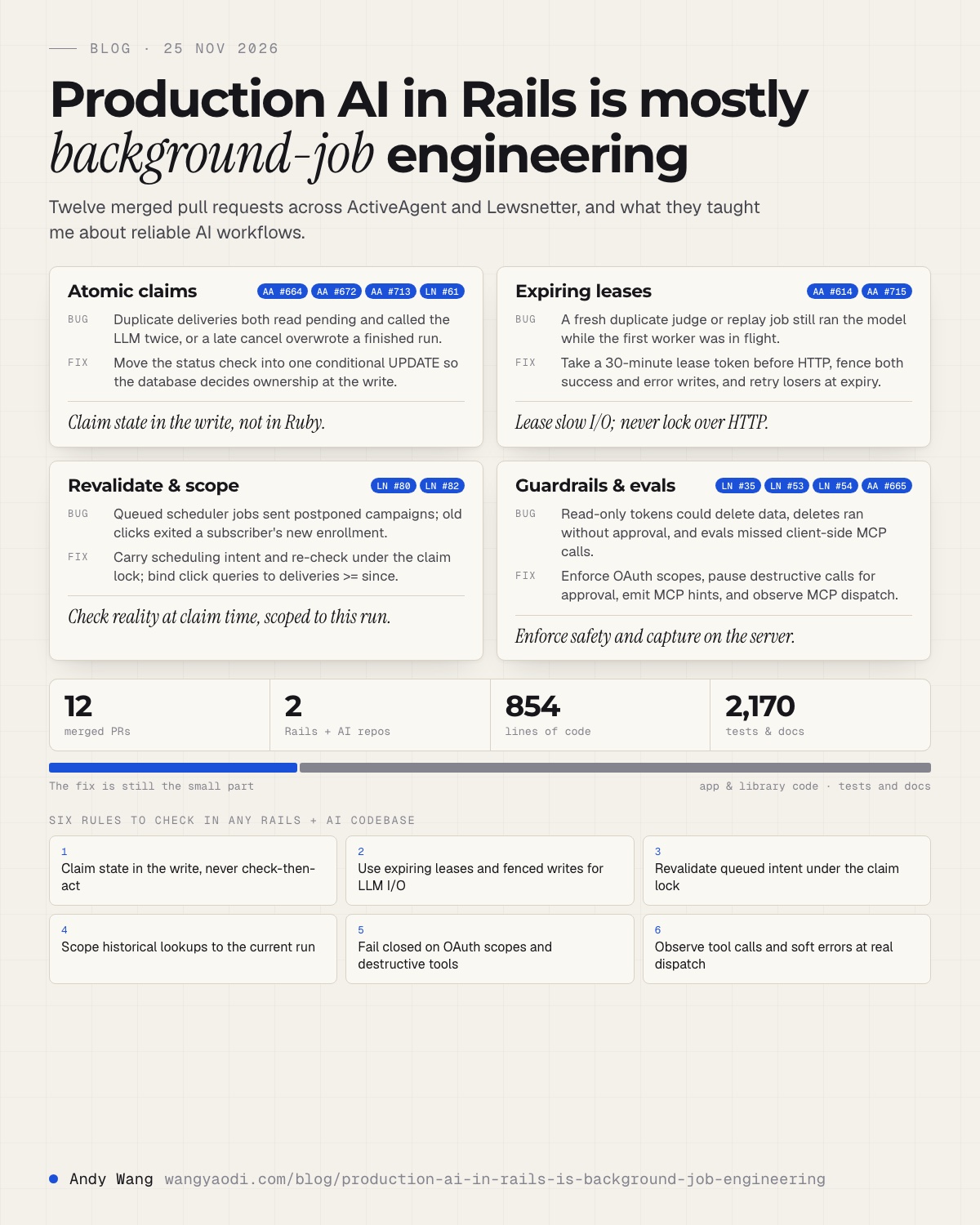
Why AI amplifies ordinary Rails job bugs
Every Rails developer knows that queues are at-least-once. Solid Queue, Sidekiq, and SQS all redeliver a job when a worker restarts, times out, or drops its heartbeat. When an ordinary job runs twice, you might recompute a counter or send a duplicate notification. When an AI workflow job runs twice, it pays for a second model generation, fires the agent's tools a second time, or corrupts an evaluation run's score.
The twelve fixes sit across four places where a Rails app hands work between a user, a queue, a database, and a language model:
Queues deliver jobs more than once, and LLM calls are slow and side-effecting. The 12 PRs guard four boundaries: atomic state claims, expiring leases for slow provider calls, claim-time revalidation and scoping, and server-side tool guardrails plus eval capture.
Claim state atomically, never check-then-act ActiveAgent #664 · #672 · #713 · Lewsnetter #61
The single most common concurrency bug in Rails jobs looks harmless in code review:
run = AgentRun.find(run_id)
return if run.finished? || run.awaiting_input?
run.update!(status: :running, started_at: Time.current)
Before ActiveAgent #664, that was AgentExecutionJob#perform. It had two gaps. First, it checked in Ruby and wrote in SQL as two separate steps: two workers that both loaded the run while it was pending both passed the check and started a generation. Second, it only rejected finished and paused runs, so a duplicate delivery arriving while the run was already running started a second provider call and overwrote started_at.
Checking run.pending? in Ruby and then calling update! lets two workers pass the check and run the agent twice. Replace check-then-act with one conditional UPDATE ... WHERE id = ? AND status = pending so the database decides at the write, on Postgres, MySQL and SQLite alike.
The fix moves the predicate into a single SQL statement:
def claim_pending(run)
  now = Time.current
  claimed = AgentRun.where(id: run.id, status: AgentRun.statuses[:pending])
    .update_all(status: AgentRun.statuses[:running], started_at: now, updated_at: now)
  return false if claimed.zero?

  run.reload
  run.broadcast_update
  true
end
There is a subtle Rails-on-SQLite lesson buried inside #664. My first commit on that branch used run.with_lock instead of a conditional update_all. CI on the rails7.gemfile matrix caught why that wasn't good enough: SQLite under Rails 7.2 opens deferred transactions, so when two workers overlap inside with_lock, the loser's write after its read is refused once the winner commits, raising SQLite3::BusyException instead of quietly declining. A single conditional UPDATE works cleanly on Postgres, MySQL, and SQLite, and holds no transaction open while the LLM runs. Because update_all skips Active Record callbacks, the helper reloads the row and calls broadcast_update explicitly.
Once you spot check-then-act in one place, look for its siblings. The exact same pattern turned up three more times:
- Cancellation (ActiveAgent #672):
AgentRun#cancel!checked its in-memory copy and wrotecancelledunconditionally. If the worker finished between the controller's load and the write, a completed run becamecancelledwhile keeping its output, and a failed run's real error was overwritten with"Cancelled by user". Moving the guard intowhere(id: id, status: CANCELLABLE_STATUSES).update_all(...)inside the same transaction as cancelling pending input requests closed the reverse race. - Evaluation runs (ActiveAgent #713):
EvaluationRunJobcheckedrun.pending?whileScenarioEvaluationRunner#callwroterunninglater. A duplicate delivery replayed the entire eval suite—or fanned out a second copy of every child job. Moving a conditionalclaim!to the top ofScenarioEvaluationRunner#callcovered every caller and also fixed a second bug where an error resolving scenario selection left the run stuck inpendingforever. - Campaign sends (Lewsnetter #61):
SendCampaignJobcheckedcampaign.status.in?(%w[draft scheduled])and then updated tosending. Two workers that readdraftbefore either wrotesendingboth mailed the audience. Wrapping the check and status update inclaim_campaign(releasing the lock before the audience query and SES calls) stopped the double send.
UPDATE or short row lock decides ownership without ever holding a database lock across an HTTP call.Lease slow provider calls without holding a DB lock ActiveAgent #614 · #715
A status transition from pending to running solves the start of a job. What about a job that sits in pending while calling an external LLM judge, or a fanned-out replay whose result row does not even exist until the agent answers?
In ActiveAgent #614, scenario evaluation fan-out already tried to guard EvaluationJudgeJob with a timestamp comparison: where(id: row.id, status: :pending, updated_at: row.updated_at).update_all(updated_at: Time.current). That only rejected a stale reader. A duplicate judge delivery that arrived after the first worker bumped updated_at read the fresh timestamp, bumped it again, and scored the same result a second time.
A timestamp check only rejects stale readers; a fresh duplicate still runs the LLM twice. Add an expiring ownership token (30-minute lease), release the DB immediately before calling the provider, fence result writes on that token, and re-enqueue losers with wait_until: expires_at so a dead worker is still recovered.
The fix adds two nullable columns—scoring_token and scoring_expires_at—and three short methods:
def claim_result!(row)
  now = Time.current
  claim = EvaluationScenarioResult.where(id: row.id, status: :pending, updated_at: row.updated_at)
  return claim.update_all(updated_at: now) == 1 unless scoring_leases?

  token = SecureRandom.uuid
  claimed = claim.where("scoring_token IS NULL OR scoring_expires_at <= ?", now)
    .update_all(scoring_token: token, scoring_expires_at: now + JUDGE_LEASE_DURATION, updated_at: now)
  @scoring_token = token if claimed == 1
end

def store_claimed_result!(row, **attributes)
  return row.update!(attributes) unless scoring_leases?

  row.assign_attributes(attributes)
  row.validate!
  EvaluationScenarioResult.where(id: row.id, status: :pending, scoring_token: @scoring_token)
    .update_all(attributes.merge(scoring_token: nil, scoring_expires_at: nil, updated_at: Time.current))
end
Notice two practical details that matter in real apps. First, both successes and failures are fenced: if a slow worker wakes up after its lease expired and fails, fail_judging! calls the same store_claimed_result! so it cannot overwrite the successor's good score with an error. Second, rolling upgrades stay safe: scoring_leases? checks whether migration 030's columns exist, so a host that upgrades the gem before migrating keeps scoring with the old timestamp check instead of crashing every judge job.
Two weeks later, ActiveAgent #715 applied the same lease design one step earlier, to EvaluationReplayJob itself. There, the result row doesn't exist until the agent finishes, so the lease lives in the run's existing fan-out JSON bookkeeping (scores["_fan_out"]["replays"])—requiring no migration at all—and fail_result! only marks a pair errored if this runner actually owns it.
Revalidate intent at claim time, and scope history to the current run Lewsnetter #80 · #82
A background job does not execute the moment it is enqueued. Between dispatch and execution, users change their minds: they postpone a scheduled campaign, cancel it back to draft, or remove its target segment.
In Lewsnetter #80, ScheduledCampaignDispatchJob checked that a campaign was due and had a valid audience, then enqueued SendCampaignJob. Once the job ran, it only checked campaign.sendable?—which is true for both draft and scheduled campaigns regardless of scheduled_for. So a queued scheduler job could send a campaign the user had just postponed or pulled back to draft.
What was true when a job was enqueued may be false when a worker claims it. Carry intent on the job (from_scheduler: true) and re-check all scheduling preconditions under the claim lock (#80); when querying past events, scope them to the current run's timestamp (#82).
The fix was small and explicit: the dispatcher now passes from_scheduler: true, and inside the existing claim lock SendCampaignJob re-checks the full scheduling contract:
def scheduler_sendable?(campaign)
  return false unless campaign.scheduled?
  return false if campaign.scheduled_for.blank? || campaign.scheduled_for > Time.current
  return false if campaign.segment_id.nil? && !campaign.all_subscribers_confirmed?

  true
end
Manual "Send now" clicks and resumes don't pass from_scheduler: true, so they keep working as before. Jobs already sitting in the queue during a deploy default to false and stay backward compatible.
Lewsnetter #82 caught the mirror image of stale state: looking backwards without a boundary. An automated email sequence checked whether a subscriber had clicked a step's link by querying ClickEvent joined to deliveries by campaign_id and subscriber_id. If that subscriber ever re-entered the sequence, a click from their previous enrollment matched immediately and exited the new enrollment before step 2 ever went out. The fix was two lines—adding .where("deliveries.created_at >= ?", since)—anchored to the timestamp stamped right before the current enrollment's delivery was created.
Put tool permissions and approvals on the server Lewsnetter #35 · #53 · #54
When a Rails app gives an AI agent tools—whether through an in-app chat or an external MCP server—prompts are not a security boundary. Tool results carry text written by outsiders (subscriber names, email subjects, web pages), so any rule that lives only in the system prompt can be talked past.
Three pull requests in Lewsnetter built a three-layer server-side boundary around its 47 MCP tools:
Never rely on a system prompt to prevent destructive tool calls. Enforce OAuth mcp:read scopes before execution (#35), pause destructive in-app agent calls on the server for explicit human approval (#53), and publish MCP readOnlyHint/destructiveHint annotations for external hosts (#54).
- Fail closed on OAuth scopes (Lewsnetter #35): The OAuth consent screen promised that
mcp:readcould only read team data, but the middleware didn't enforce scopes yet, so a read-only token could callcampaigns_deleteorcampaigns_send_now. Now read-only tools opt in withread_only(24 of 47 tools); every other tool—and every future tool by default—requires write access, and FastMcp'sauthorizehook refuses disallowed calls with JSON-RPC Unauthorized before the tool runs. - Pause destructive calls on the server (Lewsnetter #53): Four delete tools,
sequences_set_enabled, and conditionalsequences_update(only when settingstatus: "active") declarerequires_approval. RubyLLM 2.2 saves the call as pending instead of executing it, ActionCable broadcasts an Approve/Decline card with a human-readable summary fetched from the team's own record (Delete campaign "Spring launch" (#12), never a bare ID), and approving re-checks the user's team membership and CanCan ability before executing. - Surface the same metadata to external MCP hosts (Lewsnetter #54): External clients run calls immediately after token consent, so
Mcp::Server.tool_annotationstranslatesread_only,destructive, andrequires_approvalinto MCP'sreadOnlyHintanddestructiveHint—and deliberately omitsdestructiveHint: falseon ordinary writes so nothing claims safety that hasn't been checked.
# app/mcp/tools/sequences/update.rb (Lewsnetter #53)
class Update < Mcp::Tool::Base
  tool_name "sequences_update"
  requires_ability :manage, ::Team
  # An active sequence enrolls and mails subscribers by itself.
  requires_approval { |arguments| arguments["status"] == "active" }

  def approval_summary(arguments:, context:)
    "Activate sequence #{record_label(context.team.sequences, arguments["id"], :name)}: " \
      "it enrolls and sends while Sequences is on"
  end
endread_only, approvals should show the real record name rather than an opaque ID, and hints sent to clients never replace server-side authorization.Make evals see what the agent actually called ActiveAgent #665
The last failure mode is quieter than a double charge, and just as expensive over time: an evaluation suite that looks green while missing half of what the agent did.
In ActiveAgent #665, Evals::Capture recorded tool calls by wrapping the agent's tools_function. That worked for local Ruby tools, but tools served by a client-side MCP server were dispatched inside BaseProvider#call_tool_function before execution ever reached tools_function. The result: replay.tool_names came back empty for MCP-backed agents, assert_tool_called failed on tools that genuinely ran, and an MCP server returning isError (wrapped in MCPBridge::ErrorResult so the model can recover without raising) left no trace in failed_tool_calls.
Evals that wrap only local Ruby tool dispatch miss every client-side MCP tool call and silent isError response. Passing a per-instance tool_observer callback into the provider records MCP calls and failures alongside local tools with zero global hooks.
The fix passed an optional per-instance tool_observer callback from the agent into BaseProvider, wrapping only the bridged MCP branch and feeding both local and MCP calls through the same Capture.record_call helper:
# lib/active_agent/providers/_base_provider.rb (ActiveAgent #665)
def observe_mcp_tool_call(name, arguments, &call)
  return yield unless tool_observer

  tool_observer.call(name, arguments, &call)
end
Because the observer lives on the agent instance rather than a global hook or monkey-patch, concurrent evaluation runs never leak records into each other, and ErrorResult payloads are recorded as failed tool calls while still returned unchanged to the model.
Agent with mcps:, mcp_strategy: :client | Before #665 | After #665 |
|---|---|---|
replay.tool_names for one get_page call | [] | ["get_page"] |
MCP server answers isError | Not recorded | Recorded in failed_tool_calls with detail |
MCP tool raises IOError | Not recorded | Recorded with error, exception still propagates |
isError, not just Ruby exceptions.The fix is still the small part
Across all twelve pull requests, the pattern from my RubyLLM MCP post held up almost to the decimal: roughly five lines of tests and documentation for every two lines of application or library code. Every race was reproduced with tests that fail deterministically before the fix and pass after it—and for #80 and #61, reverting any single guard breaks a test.
Across the 12 pull requests: 854 lines of application and library code against 2,170 lines of tests and docs (excluding #53's commit from #54's stacked diff). Most of the work is writing deterministic failure tests for overlapping deliveries and edge states.
Show the numbers as a table
| Repo & PR | Topic | Code | Tests & docs | Merged |
|---|---|---|---|---|
| ActiveAgent #614 | Judge scoring leases | 95 | 340 | 30 Oct 2026 |
| ActiveAgent #664 | Claim pending agent run | 32 | 180 | 31 Oct 2026 |
| ActiveAgent #665 | Record client-side MCP tool calls | 100 | 440 | 31 Oct 2026 |
| ActiveAgent #672 | Cancel only while in progress | 31 | 201 | 6 Nov 2026 |
| ActiveAgent #713 | Claim pending evaluation run | 31 | 227 | 17 Nov 2026 |
| ActiveAgent #715 | Claim fanned-out replay | 109 | 163 | 17 Nov 2026 |
| Lewsnetter #35 | Enforce mcp:read scopes | 79 | 151 | 14 Nov 2026 |
| Lewsnetter #53 | Approval for deletes & activation | 313 | 274 | 16 Nov 2026 |
| Lewsnetter #54* | MCP tool annotations (net of #53) | 27 | 14 | 16 Nov 2026 |
| Lewsnetter #61 | Claim campaign before send | 12 | 25 | 18 Nov 2026 |
| Lewsnetter #80 | Revalidate scheduled sends | 21 | 118 | 22 Nov 2026 |
| Lewsnetter #82 | Scope clicks to enrollment | 4 | 37 | 22 Nov 2026 |
Six rules for production Rails + AI workflows
- Claim state in the write, not in Ruby. Use a conditional
UPDATE ... WHERE status = pendingso duplicate deliveries decline quietly across Postgres, MySQL, and SQLite. (ActiveAgent #664, #672, #713; Lewsnetter #61) - Use expiring leases and fenced writes for slow LLM calls. Never hold a database lock across a provider request, and fence both success and failure writes on the lease token. (ActiveAgent #614, #715)
- Revalidate intent when the worker starts. Carry why a job was enqueued (like
from_scheduler: true) and re-check the full contract under the claim lock. (Lewsnetter #80) - Scope historical queries to the current run. Never let a prior enrollment or run satisfy a condition for the current one. (Lewsnetter #82)
- Keep permissions and approvals on the server, fail closed. Enforce OAuth scopes before dispatch, require human approval with a clear record label on destructive tools, and expose MCP hints honestly. (Lewsnetter #35, #53, #54)
- Capture at the real dispatch boundary. If your evals miss client-side MCP tools or silent
isErrorresults, your suite is grading a partial trace. (ActiveAgent #665)
None of these requires a new infrastructure stack. They are ordinary Active Record, Active Job, and authorization habits applied where AI makes mistakes louder and more expensive. If you run a Rails app with background workflows or AI integrations that need this kind of hardening, my open-source record has the full history and my Rails maintenance page explains how I work with teams.
Limits worth knowing
Leases prevent ordinary duplicate calls, not true exactly-once remote execution. A worker that crashes right after a provider responds will still be retried after expiry, and provider-hosted MCP tools never pass through your Rails process.
- Not exactly-once remote calls: In ActiveAgent #614 and #715, a 30-minute lease stops overlapping deliveries, but a provider call exceeding 30 minutes—or a worker dying after the provider answers and before the database write—can still run again on redelivery.
- Mid-execution worker death on simple claims: ActiveAgent #664 and #713 leave a run in
runningif the worker dies after claiming it; recovering stuck runs needs a separate lease or heartbeat sweeper. - SQLite transaction semantics differ: As #664 hit on Rails 7.2, a read-then-write under
with_lockcan raiseSQLite3::BusyExceptionon deferred transactions; conditionalupdate_allavoids that, at the cost of handling broadcasts and callbacks explicitly. - Backward compatibility during deploys: Both ActiveAgent #614 (checking for migration 030 columns) and Lewsnetter #80 (defaulting missing
from_schedulertofalse) intentionally degrade gracefully for in-flight jobs queued before the deploy. - Hosted MCP tools stay invisible to local capture: ActiveAgent #665 records client-side MCP tool calls (
mcp_strategy: :client). Tools executed remotely by a model provider's hosted MCP never enter your Rails process and cannot be observed there.
Read this with an AI
This post is structured so you can hand it directly to a chat assistant or a coding agent inside your own Rails repository. A plain Markdown copy lives at /blog/production-ai-in-rails-is-background-job-engineering.md.
A Markdown copy of this post for chat assistants and coding agents is at /blog/production-ai-in-rails-is-background-job-engineering.md. The full post includes ready-made audit prompts.
Or start from one of these prompts. The first works in any chat; run the second and third inside a coding agent with access to your Rails repository.
-
Walk through the patterns
Read https://www.wangyaodi.com/blog/production-ai-in-rails-is-background-job-engineering.md and walk me through its six rules for production Rails and AI workflows, one section at a time, with a concrete failure scenario and one question for me before moving on.
-
Audit your Rails jobs
Read https://www.wangyaodi.com/blog/production-ai-in-rails-is-background-job-engineering.md and audit every ActiveJob class and service runner in this repository. List each place where a job checks status in Ruby before updating, holds a database lock across an external HTTP or LLM call, skips revalidating scheduled state at claim time, or queries historical events without scoping to the current run—with file and line numbers.
-
Audit your AI tool guardrails
Read https://www.wangyaodi.com/blog/production-ai-in-rails-is-background-job-engineering.md, then inspect every AI or MCP tool in this repository. Flag any tool that mutates or deletes data without server-side authorization or human approval, any read-only OAuth scope that isn't enforced before execution, and any tool dispatch path that bypasses eval capture or logging.
How this post was made
I wrote this post with AI, and every post here says how it was made. All twelve pull requests, their code, specs and descriptions are my own public work on GitHub:
- Sources
- My twelve merged pull requests across
activeagents/activeagentandbborn/lewsnetter(diffs, tests, and PR descriptions), listed under References. - Draft
- The article text, inline SVG diagrams, bar chart, and share cards, drafted with Antigravity from the fetched GitHub diffs and PR descriptions.
- Checks
- Every PR number, merge date, file path, code snippet, and line count verified directly against the GitHub API on 25 November 2026 (including subtracting #53's stacked commit from #54's diff).
- Review
- Read and approved by me before publishing.
If you find a mistake, tell me on X and I'll fix it here.
References
All twelve pull requests are public and merged on GitHub across activeagents/activeagent and bborn/lewsnetter.
Pull requests to activeagents/activeagent:
- #614 Prevent overlapping evaluation jobs from scoring twice (merged 30 Oct 2026)
- #664 Claim a pending run before executing it (merged 31 Oct 2026)
- #665 Record client-side MCP tool calls in eval replays (merged 31 Oct 2026)
- #672 Cancel a run only while it is still in progress (merged 6 Nov 2026)
- #713 Claim a pending evaluation run before replaying it (merged 17 Nov 2026)
- #715 Claim a fanned-out replay before the agent runs (merged 17 Nov 2026)
Pull requests to bborn/lewsnetter:
- #35 Keep
mcp:readtokens to read-only tools (merged 14 Nov 2026) - #53 Ask before deletes and sequence activation (merged 16 Nov 2026)
- #54 Mark read-only and destructive tools for hosts (merged 16 Nov 2026)
- #61 Claim campaigns before starting a send (merged 18 Nov 2026)
- #80 Revalidate scheduled sends when claiming queued jobs (merged 22 Nov 2026)
- #82 Scope click actions to the current enrollment (merged 22 Nov 2026)